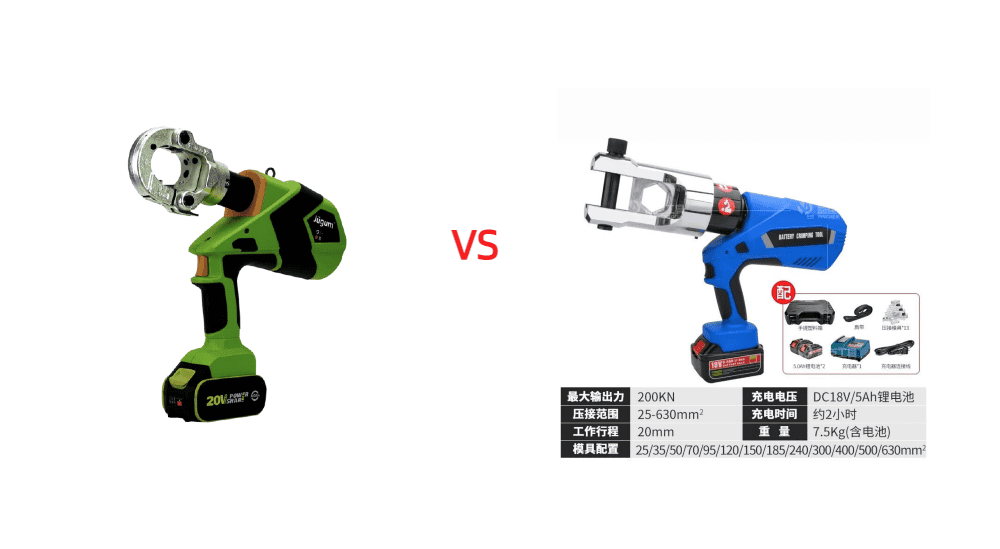
In recent years, Chinese hydraulic tools have gained significant attention both domestically and internationally. However, one striking feature of the market is the wide variation in prices. From budget crimping tools priced under $50 to premium battery-powered hydraulic systems costing several hundred or even thousands of dollars, the range can be bewildering. Understanding the factors behind this price disparity requires looking at technology, branding, production, and buyer expectations—but it also requires understanding where a brand positions itself in the market.
The Two-Tier Market: Professional Industrial vs. DIY Tools
The Chinese hydraulic tool market is fundamentally divided into two segments, and understanding this split is essential to understanding price differences.
Professional Industrial Tools are engineered for demanding, continuous use in industries such as power construction, railway, substation maintenance, and new energy. These tools prioritize reliability, safety, precision, and long service life. They use premium materials, undergo rigorous testing, and are backed by certifications such as ISO9001 and CE. Buyers in this segment include engineering contractors, utilities, and industrial manufacturers who understand that the cost of failure far outweighs the initial purchase price.
DIY / Entry-Level Tools are designed for occasional, light-duty use—home repairs, hobby projects, or simple maintenance tasks. These products prioritize low cost and basic functionality, often using lower-grade materials and minimal quality control. Their business model centers on high volume and low price, with little emphasis on long-term reliability, safety, or after-sales support.
The price gap between these two segments is not arbitrary. It reflects fundamentally different engineering standards, materials, testing protocols, and support systems. A tool designed for occasional use cannot be expected to perform like one engineered for daily industrial operation—and the price reflects that reality.
Brand Reputation, Heritage, and Market Positioning
Brand perception plays a huge role in pricing, but heritage and positioning matter even more. Jügum® is a brand of Suzhou Daojian Precise Technology Co., Ltd., focused exclusively on high-quality, professional-grade hydraulic tools. With a German technology background integrated into our engineering and manufacturing processes, we are positioned not as a mass-market supplier, but as a precision engineering partner for demanding industrial applications.
Most Chinese hydraulic tool suppliers operate in the DIY/entry-level segment—high volume, low cost, minimal quality assurance. Jügum® deliberately chooses a different path: competing on quality, precision, and long-term value rather than on price alone. This is why our tools are trusted by professional users who understand that true cost efficiency comes from reliability, not just the purchase price.
Technological Differences
The technology incorporated in a hydraulic tool directly affects its cost. Basic models often rely on simple manual pumps and single-speed hydraulic systems, while high-end models include advanced features such as two-stage hydraulic pumps, integrated pressure sensors, intelligent control PCB boards, and real-time data logging. Battery-powered hydraulic tools with Li-ion battery platforms, automatic retraction, and Bluetooth connectivity for data transfer—features that significantly increase manufacturing costs. Precision-machined cylinders, aviation aluminum alloy bodies, and heat-treated dies further widen the gap between entry-level and industrial-grade tools.
Production Costs and Supply Chain
Even within China, production costs vary widely depending on manufacturing scale, materials used, and labor costs. Large factories benefit from economies of scale, allowing them to produce high-quality units more efficiently. They also invest in lean manufacturing systems, automated assembly lines, and rigorous quality inspection at every stage.
In contrast, smaller manufacturers may cut costs using cheaper components—lower-grade seals, thinner cylinder walls, unhardened dies—leading to lower-priced models that may lack durability or performance consistency under demanding field conditions. Our pricing reflects our commitment to superior quality, reliability, and long-term performance. Unlike many suppliers who compete solely on price, we invest heavily in premium raw materials and high-strength alloys, advanced manufacturing equipment, strict quality control at every stage, comprehensive pre-shipment performance testing, product certifications (CE, ISO, RoHS), and dedicated after-sales support.
Buyer Preferences and Market Segmentation
Chinese hydraulic tool buyers have diverse preferences, which drive the existence of multiple price tiers. Some prioritize affordability and basic functionality for occasional use, while others seek reliability, safety, and efficiency for daily industrial production. Manufacturers respond by offering a broad spectrum of models—from entry-level manual crimpers to high-tech battery-powered hydraulic tools with data systems—to capture different segments of the market.
The price difference reflects what each segment is actually buying: a tool for occasional tasks, or a system engineered for years of dependable service. For professional users, the choice is clear. While our initial price may be higher than mass-market alternatives, our tools deliver greater durability, fewer breakdowns, and significantly lower total cost of ownership over their operational lifespan.
Purchase Cost vs. Cost of Ownership
Most people assume that a lower purchase price means a lower total cost, and a higher purchase price means a higher total cost. In reality, this is not the case.
For professional users, tool service life, stability, and associated downstream costs—such as downtime, repair costs, and rework expenses—have a far greater impact on total cost of ownership. When you also consider the potential quality risks associated with low-priced tools on the job site, the true cost of a cheap tool is often significantly higher than that of a high-quality one.
The purpose of providing high-quality tools is to reduce our customers’ total cost of ownership—not just the initial purchase price.
Conclusion
The wide variation in Chinese hydraulic tool prices is the result of multiple intersecting factors: technology, brand heritage, production, supply chain, buyer demand, and regulatory standards. Understanding these influences helps buyers make informed decisions and illustrates how a single market can simultaneously offer both budget-friendly and high-end options.
You always get what you pay for. With Jügum®, you’re not buying a commodity tool—you’re investing in German-backed engineering, precision manufacturing, and a partnership that extends far beyond the initial purchase. For professionals in power construction, railway, and new energy industries, the right choice is not always the cheapest—it is the one that delivers reliability, safety, and long-term value.
Choose quality. Choose reliability. Choose Jügum®.